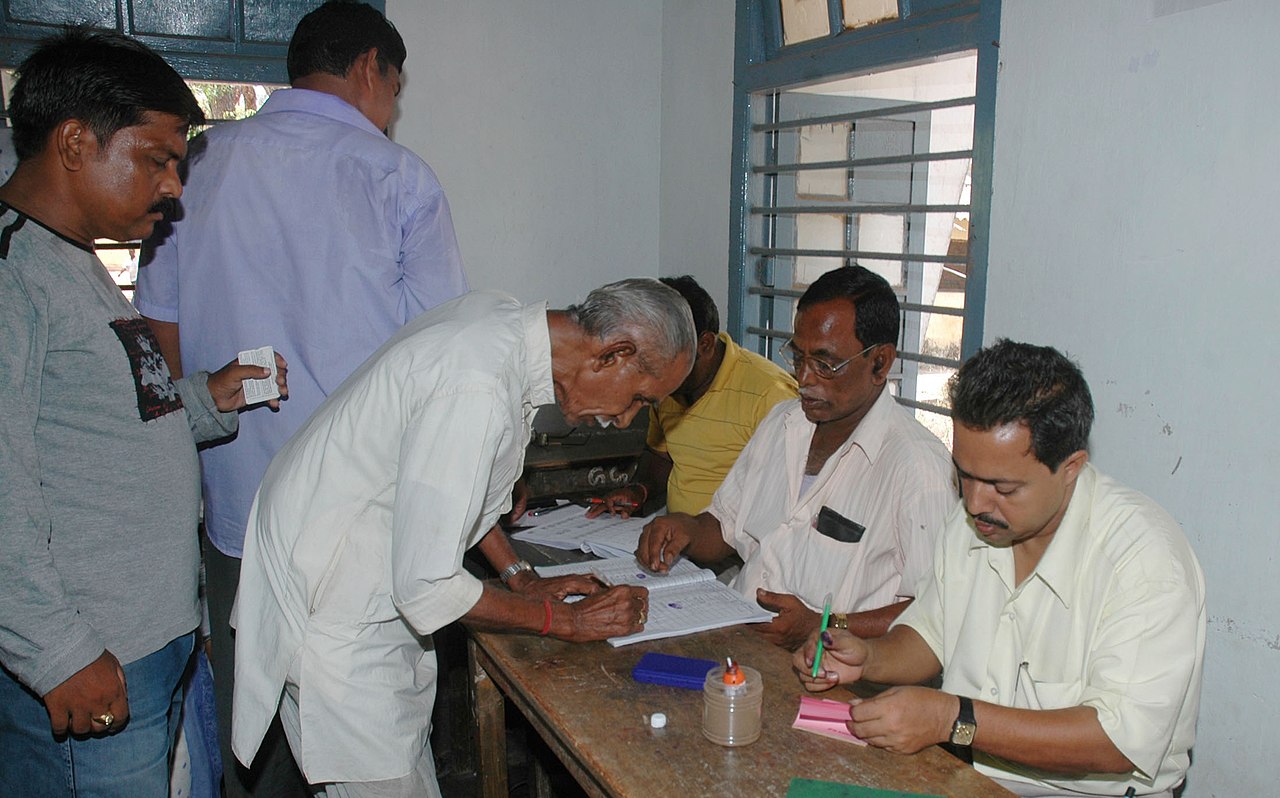
Ask what the Constitution did to caste and the obvious answers are Article 17 and reservation. But the deepest lever may be the quietest one: Article 326 — universal adult suffrage. One person, one vote handed numerical majorities their first real weight, and slowly, without a revolution, it began to move power down the caste order. Jaffrelot called this the silent revolution, and it is the clearest evidence on the whole site that the new code did not stay on paper.
The arithmetic the old code never had to face
Under the varna order, numbers were irrelevant: governance belonged to the top by birth, however few they were. Democracy inverts that. The OBCs are roughly half the population; Dalits about a sixth; Adivasis a further tenth. Once every one of them had a vote of equal value, the upper castes — a small minority — could no longer govern by right of rank. It would take decades for that arithmetic to express itself, but the arithmetic was now the law.
The South went first
The shift began in the South, well before independence. The non-Brahmin movement — the Justice Party, then Periyar’s Self-Respect movement, later the Dravidian parties (DMK) — had already broken Brahmin political dominance in the Tamil country by mid-century. [Documented] Southern politics was “plebeianised” a generation ahead of the North.
The North followed, after Mandal
North India moved later and more explosively. The Mandal Commission (reported 1980) recommended 27% reservation for OBCs; its implementation in 1990 detonated a political realignment. Out of it came the assertive rise of OBC leaders and parties, the subject of Jaffrelot’s study — a new political class drawn from castes the old order had assigned to service, now contesting and winning power in the Hindi heartland. [Documented]
The image that says it all
For Dalits, the milestone had a name and a place. Kanshi Ram built the Bahujan Samaj Party as an explicitly Dalit-led political vehicle; Mayawati became Chief Minister of Uttar Pradesh — India’s largest state, with a population greater than most countries. A Dalit woman heading the government of the Hindi heartland is something the Manusmṛti’s authors could not have conceived and would have forbidden. [Documented] It is the two codes’ contrast rendered in a single office.
The honest qualifications
This is a real achievement, and telling it honestly means naming its limits — several of them raised by the same scholars who documented the revolution.
[Debated] Political power outran economic power. Winning elections did not redistribute land or wealth at the same pace; dominant-caste economic capture persists in much of the countryside.
[Debated] Caste politics has its own pathologies. Identity mobilisation can crowd out governance; several of the movement’s parties have been dynastic and dogged by corruption cases. Empowerment and misgovernance are not mutually exclusive.
[Documented] And it is uneven and unfinished — strong in some states, weak in others; further along for some OBC castes than for the poorest Dalits, which is what drives the sub-categorisation debate.
Why it belongs on this site
The lazy verdict — “the Constitution changed nothing, caste is as strong as ever” — does not survive this record. A great deal changed, and it changed through the machinery the Constitution built: the equal vote, the reserved seat, the quota. The old code fixed power to birth and forbade the lowest from ruling. The new code fixed power to the ballot — and the ballot, given seventy years, did precisely what the old code was written to prevent. It is not utopia. It is a revolution, and it was silent because it happened one vote at a time.