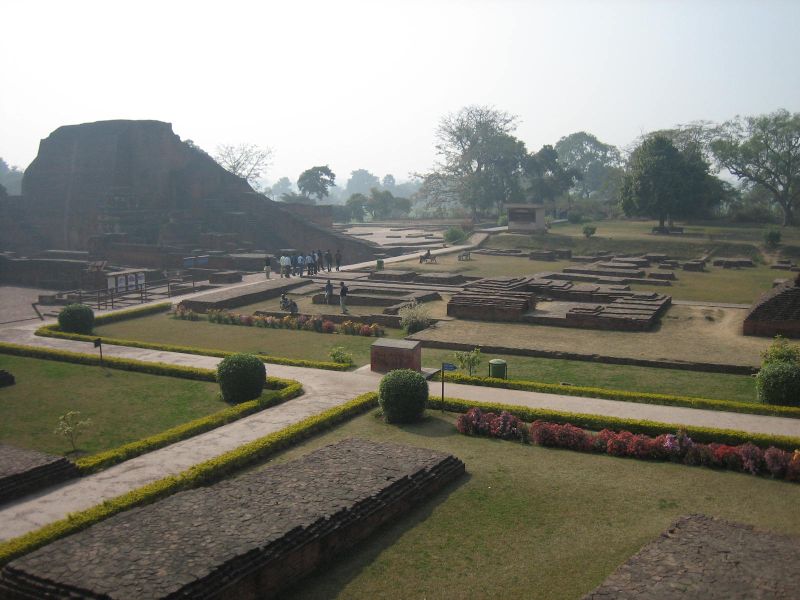
The destruction of Nalanda is one of those events everyone “knows”: nine million manuscripts, a library so vast it burned for months. It is a genuinely emotive story, and it circulates most among people otherwise sympathetic to this site’s themes. Which makes it the perfect test of whether we apply the same standard in every direction. So set the retellings aside and read the source.
The near-contemporary account
The closest source is the Tabaqāt-i-Nāsirī of Minhaj-i-Siraj, written around 1260 — within living memory of the event. Here it is in Dowson’s public-domain translation, quoted from the scan:
Muhammad Bakhtiyar with great vigour and audacity rushed in at the gate of the fort and gained possession of the place. Great plunder fell into the hands of the victors. Most of the inhabitants of the place were Brahmans with shaven heads. They were put to death. Large numbers of books were found there, and when the Muhammadans saw them, they called for some persons to explain their contents, but all the men had been killed. It was discovered that the whole fort and city was a place of study… In the Hindi language the word Behar (vihar) means a college.
What this establishes — and it is grim
[Documented] A fortified Buddhist monastery-town was stormed by Bakhtiyar Khalji’s force around 1193. Its “Brahmans with shaven heads” — the phrase is the chronicler’s; these were Buddhist monks, whom he did not recognise as distinct from Brahmins — were killed. A large library was found, and there was no one left alive who could read it to the conquerors. This is a real catastrophe for Indian Buddhist learning, and anyone who dismisses it as fabrication is also ignoring the source.
What it does not say
[Debated] Read it again for what is absent. The source says “large numbers of books,” not nine million. It says nothing about a library burning for months. Those figures are later embellishments, not testimony — the classic inflated-number move, dressing a documented atrocity in cinematic statistics it cannot support.
And there is a second imprecision the retellings smooth over: the Tabaqāt describes the fort at “Bihar” — that is, Bihar Sharif, the site of the Odantapuri monastery — which is routinely conflated with Nalanda specifically. Nalanda’s own decline was more gradual and multi-causal. Whether this passage describes Nalanda, Odantapuri, or the broader collapse of the region’s monastic universities is genuinely uncertain.
Why this one matters most
It would be easy for a site like this to let the Nalanda story run: it is vivid, it is anti-something, and it flatters a familiar narrative. That is exactly why we don’t. Keep the documented event — a real and devastating sack of a great Buddhist seat of learning, monks killed, a library lost. Drop the fabricated scale — the nine million, the months of fire, the false precision about which university. Correcting a myth your own audience enjoys is the only thing that earns you the right to correct anyone else’s. The record here is terrible enough; it does not need the myth, and the myth does not survive the record.