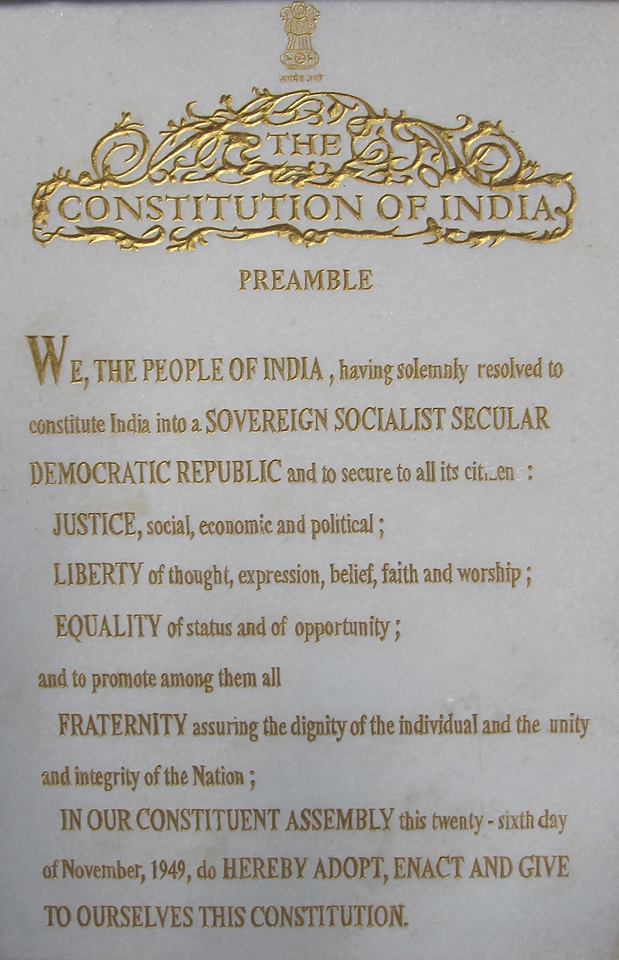
The Preamble is one sentence. It carries no enforceable rights of its own, yet the Supreme Court has treated it as a key to the Constitution’s intent. Here it is in full, as adopted:
WE, THE PEOPLE OF INDIA, having solemnly resolved to constitute India into a SOVEREIGN SOCIALIST SECULAR DEMOCRATIC REPUBLIC and to secure to all its citizens: JUSTICE, social, economic and political; LIBERTY of thought, expression, belief, faith and worship; EQUALITY of status and of opportunity; and to promote among them all FRATERNITY assuring the dignity of the individual and the unity and integrity of the Nation; IN OUR CONSTITUENT ASSEMBLY this twenty-sixth day of November, 1949, do HEREBY ADOPT, ENACT AND GIVE TO OURSELVES THIS CONSTITUTION.
Now the phrases that do the work.
”We, the People of India”
[Documented] Sovereignty is located in the people — not in a monarch, not in scripture, not in any priesthood. Under the old order, legitimacy flowed downward from sacred law and the varnas placed at its top. Here it flows upward, from every citizen equally. The Constitution is something the people “give to ourselves,” not something handed down to them.
”…do hereby adopt, enact and give to ourselves”
[Documented] The document is self-authored. This is the plainest answer to the claim that the Constitution was imposed from outside: it was adopted by an elected Constituent Assembly on 26 November 1949 and came into force on 26 January 1950. Its drafting committee was chaired by B. R. Ambedkar.
”Justice — social, economic and political”
[Documented] Note the order. Political justice — one person, one vote — is listed last, not first. Ambedkar’s warning in his final Assembly speech was precisely this: India was entering “a life of contradictions,” with equality in politics but inequality in social and economic life, and the second could undo the first. The Preamble names social and economic justice as unfinished business, by design.
”Liberty… Equality… Fraternity”
[Documented] The triad is deliberate and Ambedkar was explicit about its source — he traced it not to the French Revolution but to the teachings of the Buddha. Fraternity, he argued, was the hardest of the three and the one a caste-ordered society lacked most: without a sense of common brotherhood, equality and liberty stay on paper.
The two words added later: “Socialist” and “Secular”
[Documented] The words SOCIALIST and SECULAR, and the phrase “and integrity,” were not in the Preamble as adopted in 1949. They were inserted by the Forty-second Amendment in 1976. This matters for a reason central to this site: it is a lawful amendment under Article 368 — the system working as intended — not evidence that the original was “secretly changed.” Whether that amendment was wise is a live debate; that it was lawful is not. Keep amendment and disinformation on separate shelves.
Why the Preamble answers myths
Read closely, the sentence pre-empts a whole genre of viral claims. It says where authority comes from (the people), who wrote it (the people, in their own Assembly), what it still owes them (social and economic justice), and it wears its one major amendment openly rather than hiding it. The rest of this site is, in a sense, footnotes to this paragraph.