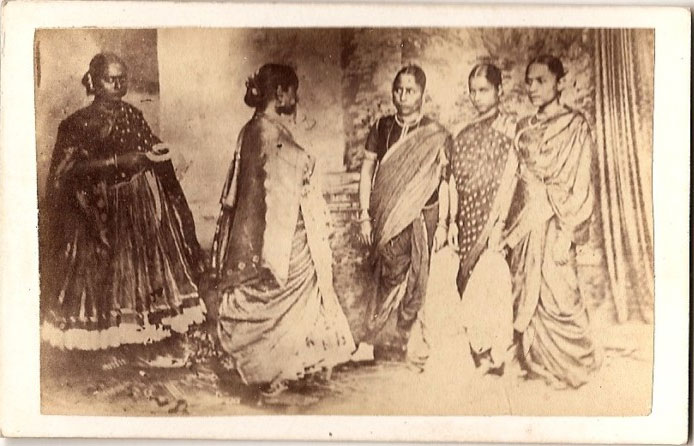
Caste was not only a matter of temples and law books. It was enforced on the body, in public, every day — and few episodes show it as plainly as the fight of lower-caste women in Travancore for the right to cover themselves.
The rule
In 19th-century Travancore, a person of low caste was expected to bare the upper body before those of higher status; covering the chest was a privilege of rank. For the women of the Nadar (Channar) climbing caste, this meant they were forbidden to wear an upper cloth over their breasts in public. The prohibition was not an oversight of poverty — it was a marker of subordination, worn on the skin.
[Documented]
The revolt
From 1813 to 1859, Nadar women — many of them converts, exposed through mission schools to a different idea of dignity — began covering themselves anyway. The backlash was violent: cloths and jackets were torn off in the street, women were assaulted, houses attacked. The struggle flared for decades, the Channar Lahala, until:
[Documented] on 26 July 1859, under pressure from the Madras Governor Charles Trevelyan, the king of Travancore issued a proclamation granting all Nadar women the right to cover their breasts — whether with a jacket, like the Christian Nadars, or a coarse cloth, like the fisher-women.
The missionaries’ part — stated honestly
The London Missionary Society was a genuine catalyst: it promoted literacy and Western-style blouses among converts, which is part of why converted Nadar women were often the first to defy the rule. That is a documented fact, and it belongs in the record — as does the honest qualification that the courage was the women’s, the movement was theirs, and conversion was one route to dignity among several, not the cause of their self-respect.
Where we stop, on purpose
This is a case where the true story is strong and the viral story is inflated — so we separate them. [Debated] The popular retelling of a “breast tax” scaled to the size of a woman’s breasts, and the story of Nangeli cutting off her breasts in protest, are contested: historians note that Mulakkaram was in fact a poll tax levied on lower-caste men, and that the Nangeli details are unverified folklore. We keep what is documented — the prohibition, the decades of revolt, the assaults, the 1859 proclamation — and we do not stake the case on the embellishments, because we don’t need to and because a single unverifiable detail is all a hostile reader needs to dismiss the rest.
The two codes on the body
The old order graded even the right to be clothed. The new code refuses the whole idea: Article 15 bars discrimination on grounds of caste, and Article 21’s guarantee of dignity has no rank. What a woman in Travancore had to bleed for over half a century, the Constitution states as a birthright — that your body is not lowered by your birth.