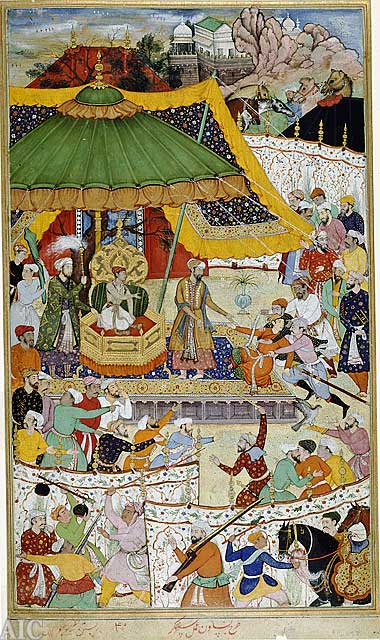
Between the Delhi Sultanate and the British lies the great Mughal century, and it is where two competing stories collide: that Muslim rule destroyed Hindu caste, or that it somehow created the caste rigidities blamed on India. The primary record supports neither. The Mughal state ran a caste society without dissolving it — and it brought a graded order of its own.
Caste persisted under Muslim rule — the outside view already knew
We have an early outside witness to exactly this. Al-Biruni, writing under the earlier Ghaznavids around 1030, described the four varnas and the untouchables outside them as a going concern — Muslim political power over the region did not erase the caste order beneath it. By the Mughal period the same holds: caste is the social substrate, and Hindu officials serve the empire as themselves. Akbar’s revenue genius Todar Mal is recorded in the court chronicle as “a Khatri by caste”; the courtier Birbal as “the Brahman.” Caste identity is noted in the Mughal record, not abolished by it. [Documented]
The empire’s own theory of ranks
What the Mughal state added was a hierarchy of its own. Abul Fazl, Akbar’s minister, opens the Ā’īn-i-Akbarī with a theory of society as a graded order the king must maintain — and Blochmann’s public-domain translation lets us quote it:
The people of the world may be divided into four classes:— 1. Warriors, who in the political body have the nature of fire… 2. Artificers and merchants, who hold the place of air… 3. The learned, such as the philosopher, the physician, the arithmetician, the geometrician… who resemble water… 4. Husbandmen and labourers, who may be compared to earth… It is therefore obligatory for a king to put each of these in its proper place.
The tell: warriors above priests
Look closely at the ranking, because the order is the argument. Abul Fazl’s scheme, mapped onto the four elements, places warriors first and the learned third — the reverse of the Brahmanical varna order, which puts the priest (Brahmin) at the apex and the warrior (Kshatriya) second.
[Documented] Two graded theories of society, coexisting in one realm: the imperial one topped by the sword, the Brahmanical one topped by the sacred thread. What they share is more important than where they differ — both are hierarchies of rank, and both make it the ruler’s duty to keep each class “in its proper place.” Graded social order was not a Hindu peculiarity; it was the common sense of the pre-modern state, Hindu or Muslim.
Caste in the fields, not just the court
Above the fields sat the imperial theory of ranks; in the fields sat caste itself. Historians of the Mughal agrarian economy describe a village order structured by caste from top to bottom: zamindars (superior landholders, typically drawn from locally dominant castes) above the peasant cultivators, and beneath them the menial and “untouchable” labour — Chamars and others — who did the work deemed polluting. The empire taxed and administered this order; it did not dissolve it. Caste was the operating system of the countryside that fed the court. [Documented] (paraphrasing Irfan Habib’s study of the Mughal agrarian system — cited, not reproduced).
The evenhanded conclusions
Three, and they cut in different directions.
[Documented] Against “Muslim rule destroyed caste”: it plainly did not — caste is documented, in the court’s own records, straight through the Mughal period.
[Debated] Against “Muslim rule created caste’s rigidities”: the varna order and untouchability predate Muslim rule by centuries (Al-Biruni, and the Dharmaśāstra before him), so this too fails; caste’s later hardening owes far more to the colonial census than to the Mughals.
[Documented] And the point for this site: pre-modern India, whoever ruled it, ran on graded rank — Manu’s varnas, Kautilya’s state, Abul Fazl’s four classes. That is the deep continuity the Constitution broke with in 1950. Article 14’s “equality before the law” is not a tweak to one of these orders; it is the first refusal of the graded principle they all shared.